
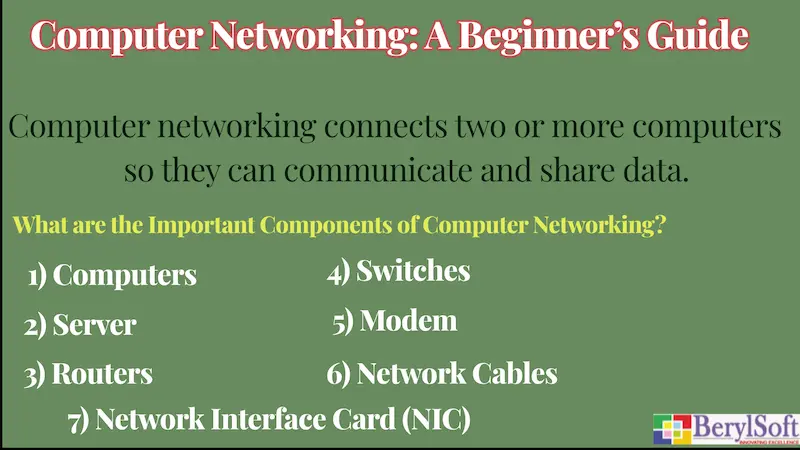
Computer networking connects two or more computers so they can communicate and share data. It also lets computers share resources, services, and information. These devices use a network and connect using wired or wireless technology to exchange information. Networks come in many types; the most common are Local Area Networks (LANs) and Wide Area Networks (WANs).
A Basic Example
Whenever a message is sent, or a user opens a website on a mobile device or laptop, the device communicates with another device over a network. Here, the network uses hardware and software resources, along with specific methods and rules, to enable communication.
What are the Components that Enable a Network?
A network uses the following devices, resources, and methodologies.
Devices
They are the primary necessities, such as mobiles, computers, printers, and servers.
Transmission Medium
The channel the network uses to transmit data signals between the sender and the receiver. Examples include wireless signals and cables.
Networking Hardware
This is the physical equipment or device that enables one computer device to connect to another. They include network cards, modems, and switches that help to deliver and direct the data.
Protocols:
These are standard protocols that ensure communication between devices. These standards are very important as they help devices understand each other. For example, HTTP and TCP/IP are some of the rules that govern this space; they help manage data effectively across the internet. These include addressing the source and destination coordinates and instructing the receiving device on how to reassemble and interpret the data into an understandable format, like text, an image, or a video.
What are the Advantages of Computer Networking?
It enables multiple users to share not only software applications but hardware devices like memory storage, scanners, and printers. It enables faster communication, reduces operational costs, and improves productivity.
Communication
Regardless of location, networking lets users communicate through voice or video calls, instant messaging, and email.
Data Sharing
It also lets users easily share documents, files, and images.
Enable Partnerships
Although people are in different locations, it becomes easy to work together on a project, enabling collaboration across different areas of expertise. Computer networking makes sharing presentations, projects, and documents easy, especially among teams, leading to better outcomes.
Widening Educational Opportunities
Students and teachers worldwide, even those in remote areas with limited infrastructure, can access educational resources offered by premier institutes. They can do so by connecting their devices to the internet, enrolling in online courses, and taking online examinations.
Online Transactions
Another big advantage is that networking enables people to perform financial transactions easily.
Simplifies Data Management
Organizations can easily update and maintain their information by backing up their old information on centralized servers, simplifying data management.
Internet Access
Organizations and individuals can connect multiple devices through a single internet network, expanding access to online services and digital platforms. Modern networks also extend into the cloud. Learn more about network connectivity in cloud computing.
What are the Different Kinds of Computer Networks?
Computer networks are divided into various types based on their geographical spread. They include LANs, MANs, and WANs.
Local Area Network (LAN)
This links devices in nearby locations, such as a home, office, or college.
Metropolitan Area Network (MAN)
This network connects multiple networks within a city or metropolitan area.
Wide Area Network (WAN)
Internet is the best example of this network. The network can span large areas, even to devices in another country or continent.
What are the Important Components of Computer Networking?
It requires various materials and resources, including hardware devices, transmission media, protocols, and software. They are as follows,
1) Computers or Mobile Devices
These are basic and important components because they help process, send, and receive data.
2) Server
Servers manage resources and store data, using a network to provide services and resources to other computers.
3) Routers
They direct the network traffic and ensure the data reaches the correct destination. They also connect various networks to transmit data between them.
Here, the server is like a warehouse that securely stores goods (data and websites), while a router is like a courier service that helps trucks reach their final destinations via the fastest route.
4) Switches
A switch is also a networking device that enables connections between multiple devices such as servers, printers, and computers. It connects devices within a local network.
The difference between a switch and a router is that a switch connects devices within the same network, and a router connects local network devices to outside networks. For example, a switch connects seven office computers, while a router links those seven computers to the internet.
5) Modem
It is another important networking device that enables the local area network (LAN) to connect to the Internet Service Provider (ISP). Simply put, a modem is like a shipping port: a truck with a full load of goods becomes a cargo ship to cross the ocean. Likewise, it sends the goods back into a truck after reaching the destination point.
6) Network Cables
They transmit data from one device to another connected device. To relate network cables to a transportation system, compare them to pavement structures like roads, bridges, and train tracks that let trucks move smoothly. While transporting goods, a truck has to pass through different kinds of roads, such as narrow pathways for a short period and, at the same time, broader national highways. Likewise, network cables come in different types, such as fiber-optic cables, Ethernet cables, and coaxial cables.
7) Network Interface Card (NIC)
Connects a device to a network. Through the NIC or a docking station, a hardware device can connect to the router or server. The NIC is a physical socket that lets you plug in a network cable so that the hardware device can connect to a network.
Real-World Scenario Where Computer Networking Works
Consider an organization with 40 employees, with each computer connected to only a single network. Then the advantages of such a setup are as follows,
Employees can work as one team and share the project details.
The manager can discuss and share the work accordingly.
Although there is a single printer, all the employees can access it for printing.
Employees can access the same internet.
The manager can successfully store completed projects on a central server.
Computer networking is a core topic in computer fundamentals. Explore more beginner-friendly guides to build a strong foundation.