
Components of a computer are its physical, tangible parts. Each computer component works uniquely to perform a specific function. All these components work together to enable the computer to perform complex functions. Overall, computer efficiency depends on each component’s unique operation. Although the central processing unit (CPU) is the main component, often called the computer’s brain, the input and output devices and the memory unit are equally important. While the input and output devices help users interact with the computer, the memory unit provides storage. Furthermore, it plays an important role in handling data and safely retaining it over long periods.
Other components, including the power supply unit, cooling system, and motherboard, handle functions such as performance, stability, and connectivity. A better understanding of these components and their functions provides a clear idea of how a computer works.
What are the Main Components of a Computer System?
The components of a computer play an essential role in its functioning. While some are very conspicuous, such as the monitor, keyboard, and mouse, others are hidden within the CPU cabinet. Among all these components, the CPU plays a major role, particularly in computer operations. The CPU, also known as a microprocessor, is the most important component of a computer, closely resembling the human brain because all computer functions are executed on it.
Computer Components List with Examples
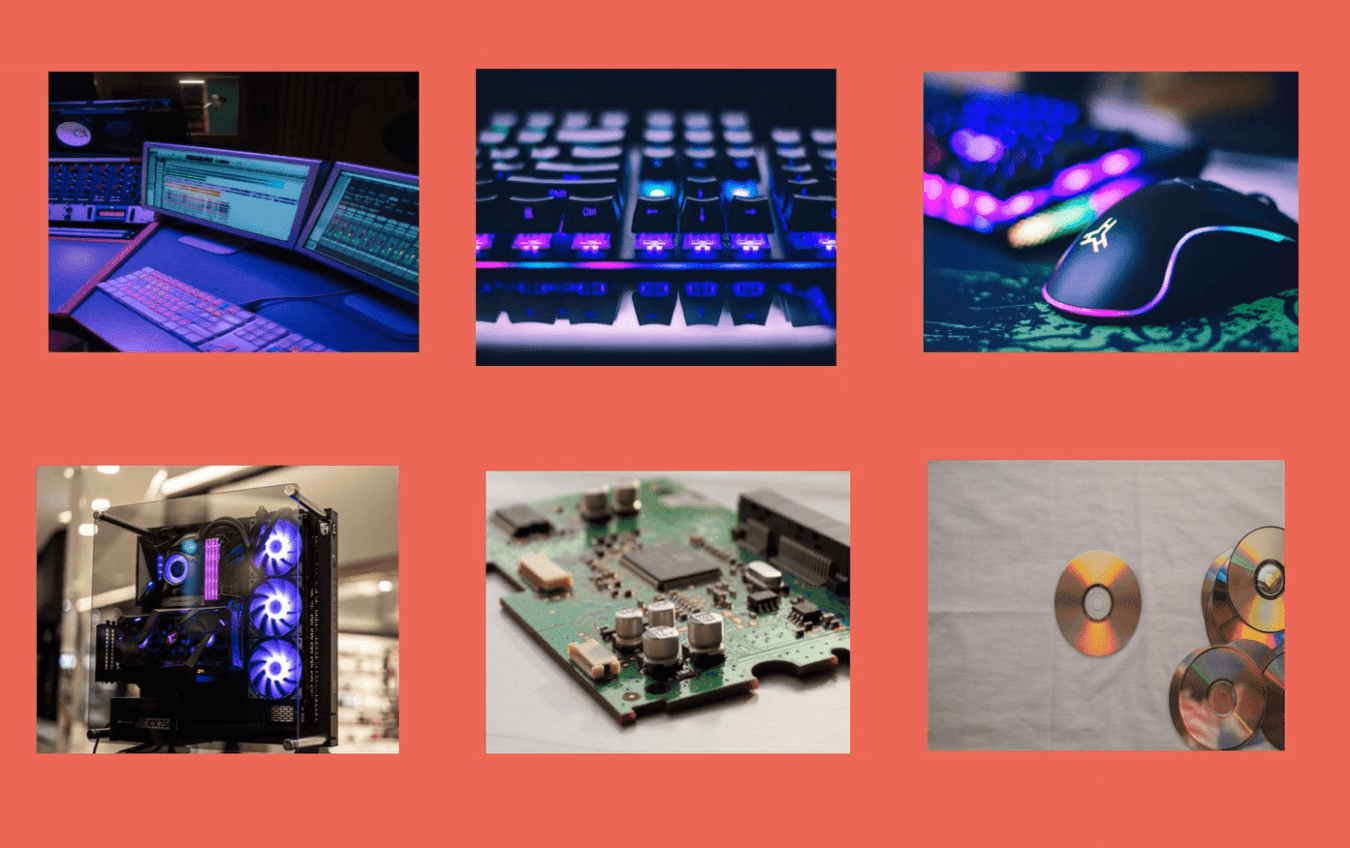
Computer hardware components are classified into three categories. They include input devices, CPU, and output devices.
1. Input Devices (With Examples)
The input unit consists of devices such as the keyboard and mouse, which enable users to enter data into the computer. The input unit connects the programmer to the computer. With the help of these input devices, the programmer or the user can feed the data into the computer.
2. Central Processing Unit (CPU)
The CPU is the core and fundamental part of a computer, as it is responsible for most of its core functions. Data processing, the core function of a computer, occurs in the CPU. The control unit, arithmetic unit, logical unit, and memory unit are its elements. While the control unit transfers instructions and data, the memory unit stores them.
The arithmetic and logical unit within the CPU is collectively known as the ALU. The arithmetic section involves operations such as addition, subtraction, multiplication, and division, while the logical section performs functions such as matching, comparing, analyzing, and selecting.
The CPU also consists of floppy disks, a hard drive, an optical disc drive, and three or four RAM modules or slots. With all the important components included, the CPU controls the entire computer’s operations. Importantly, the computer system relies heavily on memory to quickly retrieve instructions from the programming language.
Additionally, inside the CPU, we can see the power supply unit and a system fan.
3. Output Devices (With Examples)
Through the output devices, users can access information processed by the CPU. Monitor, printer, webcam, and speaker are some examples of output devices.
4. Primary & Secondary Storage
In a computer, there are two types of memory: primary and secondary. RAM is part of primary memory and is used to store data temporarily. In contrast, secondary memory includes devices such as ROM, hard drives, and USB drives and is used to store data permanently.
Primary memory, also known as RAM (Random Access Memory), consists of an array of bytes with different capacities, such as 2, 4, 8, and multiples of 8 Gigabytes. Although 8 GB or 16 GB of RAM is common, 32 GB or 64 GB can be considered for higher performance.
Internal Components of a Computer
But all these electronic, physical components of different entities must work as a single unit. And these components need instructions to work in a particular way to address computational complexities. That is made possible through software. Without software, they cannot function. It is the same with software: it requires hardware to implement the logic.
For instance, you bought a mobile phone, but making calls and using WhatsApp require various software. Otherwise, the device is like a dead one. So likewise, the purpose will not be solved if there is software but no device.
What Constitutes a Computer?
Hardware and software together constitute a computer.
Hardware + Software= Computer
Components of a Computer and Their Functions
Components of a computer are the core parts that comprise both the physical and functional aspects. While some examples of physical parts include the CPU, RAM, and keyboard, the functions performed by these parts are known as functional parts. For example, key
A Table Summarizing the Computer Components and their Functions
| Category | Purpose | Examples |
| Input Devices | Ensures capturing of raw data from the user | Keyboard and Mouse |
| Central Processing Unit (CPU) | Processes data while managing overall program execution | Arithmetic and Logical Units |
| Output Devices | Showcase processed data or information that is useful for the user | Monitor and printer |
| Primary Memory | Helps to store data temporarily, enabling program execution | RAM |
| Secondary Memory | Stores data permanently | SSD, HDD |
Thus, the computer functions as a single unit by integrating all these electronic components.